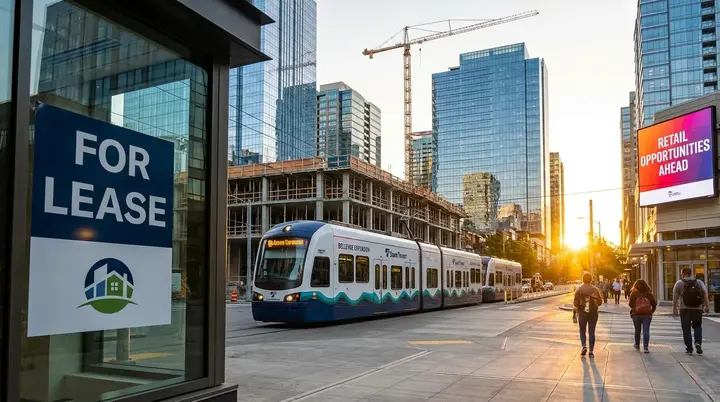
For years, the evolution of the Eastside’s commercial real estate market has been defined by the aggressive expansion of the technology sector. However, as of early 2026, a new catalyst has fundamentally altered the landscape of physical retail and asset management: the completion of regional transit. With the highly anticipated opening of the full Sound Transit 2 Line across the I-90 floating bridge in March 2026, seamlessly connecting Downtown Seattle to the Eastside, Bellevue has officially transitioned from an auto-centric suburban hub into a highly interconnected urban powerhouse.
This historic infrastructure milestone is doing much more than just moving commuters; it is rewriting the operational playbook for commercial real estate owners. Retail properties situated along this new transit corridor are experiencing a dramatic shift in consumer behavior, tenant expectations, and daily operational complexities. For landlords and investors, understanding how light rail expansion impacts ground-floor retail is critical to maximizing asset valuation and securing long-term yields.
To grasp the magnitude of this shift, one must look at the data driving the market. While the initial "starter line" between South Bellevue and Redmond Technology stations opened in April 2024, the true economic impact was fully realized with the March 28, 2026, opening of the cross-lake connection. This integration brought immediate, high-volume pedestrian traffic to previously isolated commercial pockets.
Stations like Downtown Bellevue, Wilburton, the Spring District, and BelRed are now hyper-connected nodes of economic activity. The City of Bellevue has proactively responded to this transit reality with aggressive rezoning initiatives. Recent city council actions have encouraged dense, mixed-use developments, particularly in the BelRed and Wilburton corridors. For example, massive proposals like the twin high-rise developments near the Wilburton station—featuring millions of square feet of combined residential, office, and ground-level retail space, including expansive food halls—highlight the new standard for Eastside commercial architecture.
This surge in Transit-Oriented Development (TOD) means that the traditional model of isolated, standalone retail strip malls surrounded by vast asphalt parking lots is rapidly becoming obsolete. Today, premium retail is integrated into the ground floors of towering office complexes and luxury residential buildings, situated mere steps from light rail platforms.
The demographic utilizing the 2 Line dictates the type of retail that thrives. High-earning tech professionals, daily commuters, and urban residents prioritize extreme convenience and highly curated "third places"—environments outside of home and work where they can socialize or relax.
Consequently, retail property owners are witnessing a massive shift in their ideal tenant mix. The demand for massive, big-box retail spaces is shrinking, replaced by a fierce competition for smaller, highly efficient footprints. The most lucrative retail leases in Bellevue today are being signed by premium Quick-Service Restaurants (QSRs), boutique fitness studios, specialty coffee roasters, and urgent care medical services.
These businesses thrive on the predictable, heavy foot traffic generated by transit stations. For commercial landlords, this represents a unique opportunity. Transit-adjacent properties that boast a Walk Score of 80 or above are currently commanding significant rent premiums compared to their car-dependent counterparts in outer suburban rings. However, leasing to these high-turnover, high-traffic tenants requires a retail space equipped with modern infrastructure, including heavy-duty HVAC systems for food service, advanced grease traps, and high-capacity electrical grids.
While the influx of reliable foot traffic is a massive financial boon, operating retail spaces within transit-oriented, mixed-use developments introduces a layer of extreme operational complexity. When a bustling food hall or a high-energy fitness studio occupies the ground floor of an asset where tech executives are working in the offices above, the potential for friction is high.
Property owners must navigate intricate shared systems. Odor mitigation, acoustic paneling to prevent noise transfer, and complex waste management logistics become daily priorities. A restaurant tenant generating significant waste cannot share the exact same logistical pathways as a high-end corporate tenant without meticulous scheduling and oversight.
Furthermore, the financial management of these properties becomes deeply complex. Accurately structuring Common Area Maintenance (CAM) charges in a mixed-use building requires precise accounting to ensure retail tenants are paying their fair share for high-traffic common areas without unfairly burdening office or residential tenants.
Another critical impact of the light rail expansion is the heightened need for robust security and access control. While transit stations bring valuable customers, they also bring general urban unpredictability. Retail tenants expect their landlords to provide a safe, secure environment for both their employees and their patrons. This requires investments in smart building technology, biometric access for non-public areas, elevated exterior lighting, and often, dedicated on-site security personnel. Failing to proactively manage the immediate environment around a transit-adjacent retail property can quickly lead to tenant dissatisfaction and high turnover rates.
In this rapidly evolving environment, passive ownership is no longer a viable strategy. The margin for error has vanished. Securing a prime location near the Spring District or BelRed station is only the first step in the investment cycle; executing flawless daily operations is what actually generates the yield.
Handling the rigorous demands of high-traffic retail tenants, executing complex lease negotiations, ensuring compliance with Bellevue’s stringent new ESG and building codes, and maintaining peak facility conditions requires a dedicated infrastructure. For property owners looking to capitalize on the transit boom without being consumed by the daily logistical friction, partnering with commercial property management company in Bellevue is a strategic imperative. A localized, data-driven management team provides the critical oversight necessary to balance the needs of diverse tenants, implement preventative maintenance programs, and ensure that the physical asset appreciates in alignment with the booming surrounding neighborhood.
The 2026 expansion of the light rail network is not the conclusion of Bellevue’s urban transformation; it is merely the foundation for the next decade of growth. As the 2 Line continues to expand further east toward Downtown Redmond, the ripple effects on retail real estate will only intensify.
Investors who hold retail assets in the Puget Sound must view their properties through the lens of connectivity. The most resilient and profitable retail centers will be those that seamlessly integrate into the pedestrian flow of the transit network. By aggressively curating the right tenant mix, investing in necessary infrastructural upgrades, and relying on sophisticated operational management, commercial property owners in Bellevue are perfectly positioned to reap the long-term financial rewards of the region's historic leap into mass transit.